Within the demanding realm of today's pro-level oversteer competition, success is far more than solely a product of sheer horsepower or driver courage. Instead, it has evolved into a multifaceted discipline which requires a scrupulous marriage of picking a proven chassis, outfitting it with the highest-quality drift-spec hardware, and, most importantly, grasping its dynamic characteristics on the track through sophisticated drift telemetry software. This comprehensive guide acts as your master plan from the initial concept of a project car through to the last data-informed tweaks that elevate a strong machine into a consistent winner. We will thoroughly explore the methodical process of car suspension tuning, illustrating how a modern vehicle dynamics tool like GripDial eradicates guesswork and delivers unparalleled clarity into your vehicle's real-world dynamics.
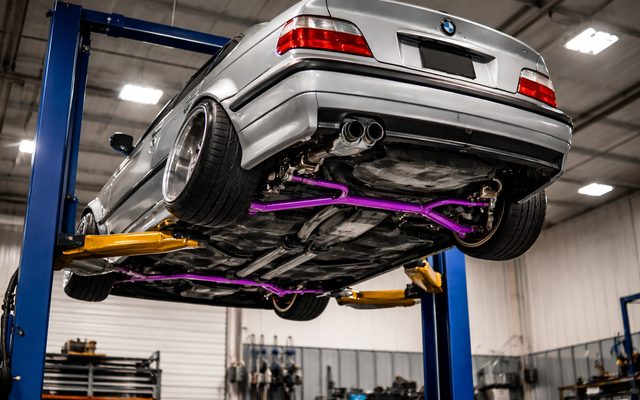
The bedrock of any exceptional drift car is, without question, the base vehicle itself. Certain vehicles have attained renowned reputation within the international oversteer community due to their inherent balance, strong design, and the enormous ecosystem of aftermarket support available. Selecting the right starting point is the first and most important selection a enthusiast will make. To illustrate, the the E36 generation BMW is widely regarded as one of the greatest overall drift platforms of history. Its almost ideal evenly distributed mass, alongside a RWD layout and extremely reliable straight-six powerplants, creates a platform that is at once forgiving for novices and incredibly capable in the possession of a pro competitor. The next step of this philosophy, the E46 model BMW, builds upon these qualities with a even more developed structure, increased track for greater confidence, and even increased steering angle as standard from the OEM. A different formidable option in the pro arena is the Corvette C6.
This V8-powered performance car brings a particular array of advantages to the sideways world, featuring a light aluminium structure, a transaxle-style transaxle that helps create an excellent front-to-rear mass ratio, and the tremendous thrust of a powerful LS-series V8 engine. This fusion renders it an complete weapon on track, designed of initiating and sustaining long angles with seemingly minimal use of throttle. For builders looking for exceptional value, the Nissan Z33 rises above as a excellent example. It comes from the manufacturer with a stiff platform, a competent OEM limited-slip differential, and the free-revving VQ35DE engine that delivers sufficient performance for learning and advancing in the discipline. Its successor, the 370Z model, brings more refinements in body strength, steering geometry, and overall powerplant output, solidifying its status as a favorite pick among professional competitors. Additional iconic vehicles that deserve consideration encompass the agile rotary-powered FC generation RX-7, the most popular Nissan S13 240SX, the torque-rich Ford Mustang SN95, the more recent E90 3 Series, and the compact yet unbelievably playful and instructive MX-5 Miata. All of these chassis provides a different set of characteristics, difficulties, and possibilities, but they all possess the fundamental ingredients necessary to serve as a serious drift car.
However, choosing the correct car is only the first step. To release the full potential of any of these vehicles, significant modifications to the steering and suspension systems are absolutely essential. This is where the world of performance drift-spec parts enters critical focus. The single most transformative improvement for a purpose-built competition vehicle is the fitting of a drift-spec angle modification kit. These advanced systems, such as those developed by performance brands like specialist manufacturers, are engineered to dramatically increase the chassis's possible turning lock. A standard street car is highly restricted in how far its front wheels can turn, a safety trade-off for on-road operation. In sliding, but, extreme steering input is continuously required to manage and hold a drift. An angle kit exchanges the OEM steering knuckles, linkages, and often control arms with pieces that enable the wheels to reach angles over 70 or even 80 degs, compared to a normal factory angle of around 40 to 50 degs.
This tremendously expanded steering angle gives the driver with significantly greater authority during a slide, enabling it to be much more straightforward to start a oversteer moment, hold it through a extended bend, and transition fluidly from one direction to the opposite. The difference in controllability is nothing short of transformative. Paired with a correctly specified steering kit is the every bit as vital enhancement to the vehicle's suspension. Store-bought or even expensive sport adjustable suspension are simply not intended for the particular and harsh demands of drifting. A drift-spec pair of adjustable dampers is paramount. These engineered dampers have specific valving and spring strength that are optimized for the extreme load shifting that is inherent of drifting. When a driver begins a slide, the car's mass is shifted rapidly to the outer of the corner. Optimal competition dampers manage this transfer in a controllable way, allowing the vehicle to stabilize rapidly and giving the operator precise feedback through the controls and driver's seat. They also enable precise setting of ground clearance, damping rate, and cross-weight, which are all integral elements of dialing in the vehicle's behavior to a specific venue or driving approach. In combination, a top-tier steering angle kit and a properly selected set of competition coilovers are the absolute hardware foundation upon which all future tuning is based.
Once the core components is installed, the following essential phase in the build is the detailed tuning of the vehicle's wheel angles. This is the domain of vehicle alignment optimization, a process that can feel intimidating to the uninitiated but is, in practice, the key to turning a assembly of fast pieces into a unified and predictable machine. The most debated aspect of suspension geometry for drifting is definitely camber angle. Camber is the tilt of the wheel relative to the perfectly straight line when observed from the front-on of the vehicle. If the top edge of the tire is tilted inward, this is referred to as inward tilt. For drifting, negative camber on the steering tires is generally employed and is seen as necessary. The reason is fundamentally linked to vehicle dynamics.
When a vehicle is going around a bend at high angles, the frame leans to the external of the bend. This chassis roll makes the outside steering tire to reduce its optimal contact patch with the tarmac. By introducing negative camber, the wheel is pre-leaned to account for this lean. As the vehicle rolls into the corner, the tire flattens out with the asphalt, optimizing its traction at the exact moment when it is needed most for directional command. Commonly, front axle adjustments for a competition drift car range from approximately -3 degrees to as much as -5 degrees or even greater, based on the details of the car configuration, compound type, and operator style. The rear axle tires also use inward lean, but the values are usually more conservative and less aggressive than the front axle. Overly aggressive camber at the back can result in the chassis extremely prone to oversteer and hard to predict on acceleration application, as it diminishes the usable grip area of the driving wheels during forward throttle application. Therefore, rear angles are commonly in the range of -1 degree to -3 degrees, striking a careful equilibrium between giving enough cornering bite to assist in starting and sustaining the angle while still preserving effective traction for exiting the corner. camber angle is just one part of the more complex alignment puzzle, which also encompasses toe setting, caster angle, and suspension-induced steering adjustment.
Toe setting refers to the direction of the tires when viewed from the top. Positive toe means the front edges of the wheels are nearer together than the trailing edges, while toe-out means the reverse. For oversteer, a small amount of front toe-out is commonly employed to sharpen the initial response handling feel, making the vehicle feel more agile and ready to initiate a oversteer moment. Rear toe is generally set to zero or a incredibly small amount of toe-in to encourage stability under throttle. Caster is the longitudinal or rearward inclination of the steering axis when observed from the side of the chassis. Positive caster angle enhances self-centering and stability confidence, and it additionally increases negative camber effect during turning, which is highly useful. Tuning these values is a intricate interaction where a adjustment to a single parameter can and will impact the remaining parameters. The conventional approach for setting a chassis's alignment for sliding has historically been a labor-intensive process of experimentation and feeling. A driver or crew would introduce a adjustment based on a hunch, run the chassis on track, use the operator's subjective sensation and comments, and then introduce another change. This cycle would repeat over and over until the chassis felt "acceptable" or the allotted testing time ended. This system is not only incredibly slow in terms of man-hours and resources, but it is also fundamentally flawed.
Human feel is a famously inconsistent metric, colored by numerous factors such as tiredness, evolving track surfaces, weather, and merely the mindset of the driver on that given session. What feels "oversteery" on one lap might feel "understeery" on the following lap, leading to conflicting information and ineffective adjustments. This age-old problem in car suspension tuning is specifically where state-of-the-art technology has intervened to revolutionize the process.
The development and application of advanced vehicle dynamics tools has ushered in a new age for tuning and refining competitive sliding vehicles. These platforms, exemplified by innovative solutions like data acquisition tools, function by directly measuring the live physical behavior of the chassis as it is operated on the track. In contrast to using driver feedback, these devices collect quantifiable data on key parameters such as shock absorber movement, wheel speed, acceleration forces, steering angle, and accelerator and brake pedal position. This acquired telemetry is then interpreted by powerful applications that can visualize and analyze the information in a comprehensible format. For the first time ever, drivers and builders can see exactly what the vehicle is exhibiting at every point of a slide. This capability changes the complete suspension tuning workflow. Imagine the specific goal of setting the front axle camber for a given chassis. Rather than applying a modification from -3 degrees to -3.5 degrees and then testing several laps to try and "sense" a difference, a suspension tuning tool can deliver instant and clear feedback. The tool can indicate graphically how the suspension's loading is behaving during the key phases of a slide: initiation, mid-corner, and switch. It can reveal if the car alignment tuning present value is enabling the loaded tire to maintain optimal grip or if the rubber is working inefficiently on its external edge.
The tool can after analysis provide empirical recommendations for change. Perhaps the information reveals that the outside front tire is even stressing its sidewall at -3.5 degrees of camber, implying that even more angle, say -4 degrees, might be beneficial. On the other hand, the data might show that the tire is failing to achieving heat or that the inside edge is wearing too quickly, which could indicate that there is excessive angle and a small decrease back to -3.2 degrees would be more efficient. This level of accuracy and actionable intelligence was literally unimaginable in the time of exclusively manual setup.
The effect of using a advanced vehicle dynamics tool extends well beyond merely optimizing camber. It becomes an priceless coilover setup tips that is specific to your specific car. When fine-tuning the rebound and compression values on your suspension, rather than using general advice or copying another driver's setup, you can use the data to analyze how the vehicle is performing in reaction to your adjustments. The tool can graph the wheel movement path over a section of track, showing if the shocks are managing the body movement optimally or if they are causing the car to oscillate uncontrollably after a flick. It can help in diagnosing issues like hitting the bump stops or topping out, enabling you to make data-backed decisions to preload settings, rebound/compression values, or ride height. This approach translates just as well to the detailed process of suspension geometry optimization. Beyond camber angle, the tool can provide insight into how adjustments to toe settings and caster are impacting the car's handling during specific maneuvers of a slide. For example, it can assist you to find the optimal amount of front toe-out for your particular steering rack geometry and competition approach by showing the response time of initial reaction and the stability of the car at lock lock. This transforms the system an extremely useful vehicle dynamics manual that is constantly updated by the real-world dynamics of your own vehicle on the circuit. It elevates the entire process from a subjective car alignment tuning skill into a repeatable engineering process.
Additionally, drift suspension tuning guide the application of a system like modern telemetry is not at all confined to experienced teams with large resources. For the grassroots driver, it serves as an amazing force multiplier. It in essence provides the driver with the analysis of a full-time suspension specialist without needing the typical cost. It speeds up the tuning process by providing unambiguous directions to questions that would traditionally take countless track days of experience to answer. A tuner can see how their specific car behaves to different inputs, developing a more intuitive knowledge of vehicle dynamics in the endeavor. It additionally democratizes advanced performance tuning principles, allowing every enthusiast with the ambition to optimize their machine to do so in a efficient and effective way. This is notably important in a discipline like drifting, where tuning expertise has historically been a tightly held advantage among top drivers. In the modern era, that knowledge can be in the garage of every motivated enthusiast.
In summary, the path to constructing and tuning the perfect high-performance sliding vehicle is a multi-faceted endeavor that perfectly integrates proven hardware knowledge with cutting-edge digital solutions. It begins with the informed selection of a legendary car, then enhanced by the integration of critical performance parts like maximum-angle drift angle kits and properly selected performance coilovers. The process then advances into the precision stage of alignment optimization, where parameters like negative camber, toe setting, and caster are precisely configured to suit the vehicle's modified capabilities and the operator's personal needs. Ultimately, and what genuinely distinguishes the modern approach from the traditional methods, is the use of a advanced vehicle dynamics tool. This system eliminates the approximation and waste of solely subjective adjustment by delivering quantifiable, real-time information on how the car is actually functioning. It serves as an indispensable engineering partner, a comprehensive drift suspension tuning guide, and a comprehensive performance analyzer. In unison, this integrated methodology ensures that every component of the competition vehicle—from the pick of the platform to the last click on the damper—is perfected for peak competitiveness on the track. It represents the total maturation of the discipline of drifting, connecting physical driving skill with precise vehicle setup to build the most dominant cars possible.